


If you regularly wear vinyl gloves on the job, economics are likely the No. 1 reason why.
Vinyl gloves are inexpensive to manufacture and sell for less than nitrile or latex. That makes them an attractive option for industries that require frequent glove changes, like jan/san or food service.
Made from polyvinyl chloride (PVC), they are also free of latex proteins and sensitizing substances that can cause allergies, making them a good option for people with latex allergies.
As opposed to form-fitting nitrile and latex, vinyl gloves have a loose fit and feel soft on the skin. The fact that they are easy-on, easy-off is another reason to choose them for frequent glove changes.
AMMEX carries a number of vinyl gloves suited for multiple applications. X3 Clear Vinyl (GPX3) is the workhorse of the team—it’s the most popular of our vinyl gloves and is easily categorized as an all-around product. There is also Gloveworks Clear Vinyl (IVPF), which handles many of the same tasks with ease.
For a bit more of a specialty glove, try Gloveworks Blue Vinyl (IVBPF). It’s a high-visibility product that is great for working with food—especially for bakers and those who handle seafood. If a bit of glove should become detached, the color makes it easier to find before it ends up in the finished product.
There is also AMMEX Professional Clear Vinyl (VPF), an exam-grade glove suited for medical applications.
All of these gloves can handle most non-harsh cleaning solutions and do yeoman’s work in environments from food service to jan/san to beauty & salon, and a lot more.
Beyond that? You’ll need to lower your expectations. Vinyl gloves simply don’t measure up to nitrile and latex when it comes to resisting chemicals, tears, and punctures.
It in no way means they are bad—for what they do, they’re a great bargain. Just don’t expect them to perform like tougher, more durable glove materials. They also come up short in fit, feel, dexterity, and tactile sensitivity.
Permeation rates for vinyl by harsh chemicals are way above normal. Super light-duty tasks are fine but if you’re doing large amounts of work, with strong chemicals, you may end up with more exposure than you bargained for.
So what’s the solution? With latex gloves always carrying the threat of spreading allergies, all roads lead to nitrile. Light-duty nitrile gloves deliver much better performance for not much more cost.
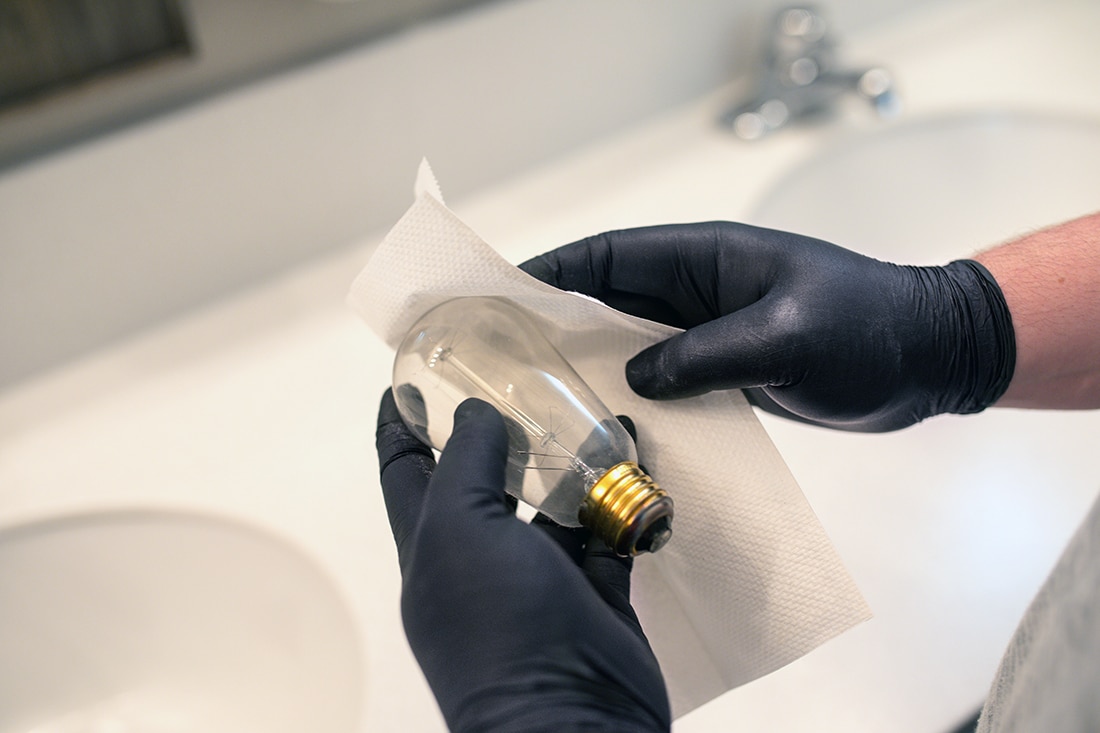
X3 Black Nitrile (BX3), pictured above, and X3 Blue Nitrile (X3) are a terrific bargain considering that you get much greater hand protection from them. They also offer greater fit, feel, and dexterity to make doing complex tasks easier. Both are 3 mils; if you need more heft, the 5-mil Gloveworks Black Nitrile (GPNB) is the way to go.
Don’t take chances with your hand safety. Nitrile is the best choice for just about everything.