Raw Material Volatility Shaped the Disposable Glove Market

Raw material availability has impacted the disposable glove market in unique ways as we move deeper into Q3. We explore this topic further in our quarterly Disposable Glove Market Update. While glove supply is available across key production regions, the market continues to feel the effects of constrained and variable access to high-quality raw materials, especially Nitrile Butadiene Rubber (NBR), a critical input for nitrile gloves. The issue is not simply whether factories can produce gloves. It is whether they can secure a consistent supply of raw materials, manage cost volatility, and maintain performance standards in an unpredictable sourcing environment.

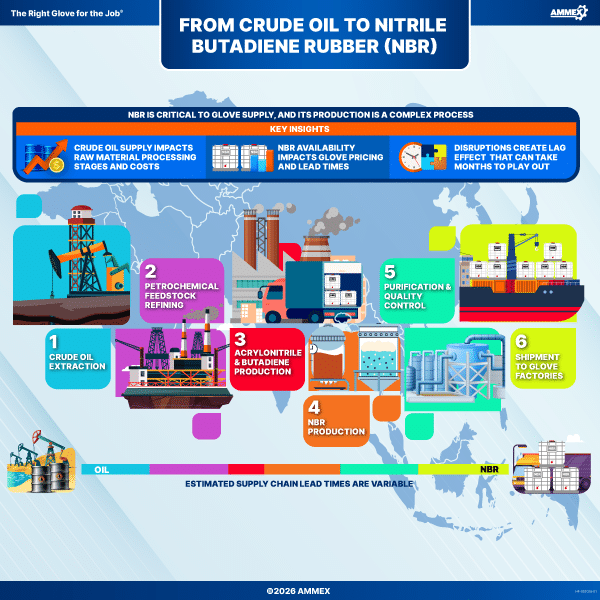
The update highlights how geopolitical instability in the Middle East has affected crude oil supply and refinery output in Asia, where raw materials, specifically NBR, are produced. These disruptions has contributed to unusual market conditions for disposable gloves. As raw material supply patterns shift, NBR producers in China have taken on a larger role in supplying glove factories across Southeast Asia. This change has helped support production, but it has also added complexity to sourcing and quality management.

Manufacturers are navigating this environment by using alternative or blended raw material sources. That flexibility can help maintain supply, but it also introduces a new challenge: consistency. Disposable gloves are performance products. Buyers depend on them for fit, durability, barrier protection, and reliable performance in demanding environments. When raw material sources vary, manufacturing discipline becomes even more important. Without strong process control, variability in inputs can translate into variability in finished product performance.

This is why quality and sourcing considerations are becoming more important in Q3. It is no longer enough to ask whether a supplier has product available. Buyers also need to understand how that product is being sourced, inspected, and validated. Increased reliance on multiple raw material sources requires stronger technical expertise and tighter factory-level oversight. Suppliers with direct factory engagement, robust inspection protocols, and diversified sourcing networks are better positioned to manage these risks. AMMEX’s team of local experts ensures that these important questions are asked and all detailed quality controls are implemented during our sourcing processes, with 100% of shipments inspected at the factory.

Supply conditions are improving as the market moves into the second half of 2026. For buyers, the practical implication is that sourcing strategy now carries more operational importance. In a volatile raw material environment, the quality of the supplier relationship matters as much as the quoted price. Buyers should consider placing greater weight on supplier transparency, manufacturing oversight, and the ability to maintain product consistency across replenishment cycles.

AMMEX’s perspective in the Q3 Market Update reflects this approach. With a dedicated team of experts on the ground in Southeast Asia, we actively manage sourcing, logistics, and supplier relationships to support supply continuity and quality performance. Our teams are working with manufacturing partners to validate raw material inputs, strengthen factory-level oversight, and maintain compliance standards.

As Q3 unfolds, raw material volatility remains more than a cost story. It is also a quality, availability, and planning story. Buyers can leverage that understanding to be in a better position to protect their operations from disruption and maintain confidence in the products they rely on every day. AMMEX can help make that possible.

AMMEX® The Right Glove for the Job®


Disposable Glove Market: Stable Demand, Shifting Costs

Disposable Glove Market: Stable Demand, Shifting Costs

As we outline in detail in our Q3 Market Update, the disposable glove market enters Q3 2026 with steady but shifting pricing conditions. Across healthcare, industrial, food service, janitorial, and other end-use segments, glove usage remains resilient. The current conditions are not being driven by demand, but by the supply side, where raw material costs, production timing, and global disruptions continue to shape the disposable glove market.

In more typical market cycles, stable demand might suggest a calmer pricing environment for buyers. But disposable gloves are deeply connected to upstream inputs, manufacturing schedules, international shipping, and replenishment timing. Even when global oil prices stabilize or decline, relief does not immediately move through the glove supply chain. Higher-cost materials that were already purchased and placed into production still must pass through manufacturing, shipping, and distribution before they reach the buyer. That creates a lag effect, in which today’s commodity movements may not be reflected in disposable glove prices for months.

Manufacturers are still working through embedded costs, short-term contracts, and inventory already tied to higher-priced inputs. As a result, glove pricing can remain elevated even after upstream costs begin to soften. That disconnect limits visibility for both suppliers and buyers and makes short-term price forecasting more difficult.

The result is a market where price movement feels less predictable than demand itself. Demand fundamentals are stable, but cost structures remain dynamic. Manufacturers have already passed through cost increases across nitrile and vinyl categories, reflecting labor, freight, raw material, and geopolitical pressures. These pricing actions have helped maintain supply continuity, but they have also kept North American pricing elevated.

For procurement teams, the takeaway is clear: Q3 is not a market for assuming that stable demand means stable pricing. It is a market that rewards planning and communication. Buyers who look only at current commodity indicators may underestimate the time it takes for cost relief to reach finished goods. Buyers who understand replenishment cycles, contract timing, and embedded input costs will be better prepared to manage expectations internally.

In practical terms, this means glove buyers should focus less on chasing the lowest near-term price and more on building visibility with suppliers. Forecasting, inventory planning, and supplier alignment are more valuable in this environment than reactive spot purchasing. The current market favors organizations that can plan, communicate expected usage, and work with suppliers that provide transparent guidance.

Stable demand may sound reassuring, but Q3 2026 remains a dynamic market. For buyers, the most effective response is not to wait for instant price relief, but to plan around the reality that glove costs may remain elevated through upcoming replenishment cycles. As highlighted in the Market Update, the AMMEX team is prepared to help buyers navigate choppy conditions in the glove market.

AMMEX® The Right Glove for the Job®


Keys to the Value of Service in the Disposable Glove Industry

Keys to the Value or Service in the Disposable Glove Industry

In the disposable glove industry, product performance often gets the most attention. Durability, performance, hand protection, and compliance to glove standards all matter, but they’re only part of the story. Behind every reliable glove program is something just as critical: dedicated service and support.

Gloves are not true commodities when safety, uptime, and compliance are on the line. When product availability is inconsistent, communications and specifications are unclear, or questions go unanswered; the consequences can ripple across an entire operation. That’s why, in today’s volatile glove market, strong support isn’t optional; it’s essential.

At AMMEX, service begins long before an order is placed. Customers prefer to work with glove experts who understand the unique environments where gloves are used, from automotive and industrial settings to food service and medical applications. The focus isn’t on selling a product, but on helping customers choose the right glove, one that balances protection, performance, comfort, and cost.

Through clear communication, educational content, application guidance, and tools like Glove Finder, AMMEX helps customers and distributors make informed decisions with confidence. Instead of guessing, they gain clarity on how gloves perform in real-world conditions and how small choices can improve safety while reducing waste and costs.

At AMMEX, reliable service means reliable supply. We invest heavily in redundant sourcing, global logistics, and 100% in-person factory inspections to deliver consistency in an unpredictable market . This has been especially important under current market conditions.  Due to the conflict in the Persian Gulf, the disposable glove market has experienced a significant impact on supply and service. Both nitrile and vinyl gloves rely on oil-derived synthetic materials, and disruptions to global oil supply have affected the availability and pricing of key inputs, including Nitrile Butadiene Rubber (NBR) and Polyvinyl Chloride (PVC).

What truly sets AMMEX apart is our growth mindset. We don’t see ourselves as a transactional vendor, but as a long-term partner, regardless of market conditions. Every interaction is guided by the belief that better service leads to better outcomes for workers, for businesses, and for the people relying on disposable gloves every day.

Because at AMMEX, the right glove is backed by the right service.

AMMEX ® The Right Glove For The Job ®

Disposable Gloves: How Quality and Compliance Stand Out at AMMEX

Disposable Gloves: How Quality and Compliance Stand Out at AMMEX

In the volatile disposable glove industry, quality and compliance are not interchangeable with price. A glove that looks acceptable on the surface can fail in performance, consistency, or regulatory requirements, putting workers, operations, and brands at risk.  

The conflict in the Persian Gulf has had a broad impact on the industry. Both nitrile and vinyl gloves rely on oil-derived synthetic materials, and disruptions to global oil supply have affected the availability and pricing of key inputs, including Nitrile Butadiene Rubber (NBR) and Polyvinyl Chloride (PVC). 

Refineries across Asia have experienced significant disruption. Historically, producers in Korea, Taiwan, Malaysia, and Japan have been stable and reliable sources of NBR for glove manufacturers in Southeast Asia. However, traditional NBR suppliers faced disruption in securing a consistent supply of crude oil from the Persian Gulf. This has forced glove manufacturers to seek alternative NBR sources, primarily from China. 

In the past few months, Chinese refiners have been securing a more predictable supply of crude oil from a variety of sources. This introduces increased variability in raw material quality into the market. Compared to long-established suppliers used by factories in Southeast Asia, quality and consistency can vary significantly between producers and batches. This variability can potentially impact glove performance,  

At AMMEX, quality and compliance processes are core operational pillars. Our dedicated staff utilizes inspections, decades of local experience, and documentation to prevent quality issues before shipping. Our teams in the US and Asia are actively working to mitigate negative market impacts and secure a consistent supply of gloves for our customers. We are optimizing our supply across a network of redundant vendors, communicating market conditions to clients, and distinguishing ourselves with dedicated quality and compliance resources. 

Most products meet general glove standards, but our products are inspected onsite by our team members using our criteria. Inspections ensure our gloves meet and exceed our customer requirements and the ASTM standards. We bring in thousands of containers per year, and preventative quality assurance processes ensure you get the right gloves. 

We have a robust Compliance Program that combines ethical sourcing policies, processes, and audits. We use both SMETA and internal audits to proactively identify issuesand solve them together with our production teams to deliver quality products to you. Our program combines extensive controls of a vertically integrated supplier and, at the same time, enables flexible, multi-source production that reduces compliance risks and delays. ​You can trust AMMEX to ensure your gloves are produced to industry standards.  

In a global glove market with wide variability in manufacturing practices, these exceptional levels of oversight matter. Market volatility has made the availability of disposable gloves unpredictable. But consistent access to gloves only matters if the product performs as expected. AMMEX reliably delivers through inperson inspections on every shipment, proactive vendor compliance, and ethical sourcing practices. 

AMMEX® The Right Glove For The Job ® 

Navigating the Disposable Glove Market: What Customers Need to Know

Geopolitical pressures are once again reshaping the disposable glove market, and we are amid a period of volatility. As you are likely aware, the ongoing conflict in the Middle East has triggered significant disruptions across oil supply chains, creating downstream impacts on raw materials that are essential to disposable gloves.

Both nitrile and vinyl gloves rely on the availability of oil. Specifically, the supply of synthetic materials such as Nitrile Butadiene Rubber (NBR) and Polyvinyl Chloride (PVC) is processed by downstream refineries. It’s no secret that disruptions to global oil supply have impacted the availability of raw materials and driven disposable glove costs higher. Because the production of both raw materials and gloves is heavily concentrated in Asia, these disruptions affect the supply and pricing of disposable gloves in North America.

Higher raw material costs have translated into higher glove prices across all material types, including nitrile, vinyl, and even latex, which is experiencing increased demand as buyers look for alternatives. While the precise pricing dynamic is still unknown, the direction of the market is clear, with prices much more likely to move higher than lower in the foreseeable future.

So, what can disposable glove buyers do about this? To start, it helps to work with a reliable supplier. For example, to maintain continuity of supply, AMMEX is taking decisive actions. We are in direct communication with our customers, actively managing existing inventory, and working around the clock to ensure a reliable supply of disposable gloves.

Importantly, we are preparing for future market volatility. Even if the effects of the conflict in the Middle East were to subside quickly, disposable glove pricing pressures will not disappear overnight. The fact remains that oil-derived materials require extensive processing, and improvements in crude supply or pricing flow through the supply chain slowly and unevenly. Short‑term stabilization does not eliminate near‑term cost pressures.

At AMMEX, our priority is to continue supplying quality disposable gloves as consistently and transparently as possible during highly dynamic market conditions. We look to proactive communication and disciplined operational control as essential to navigating the months ahead.

How the Disposable Glove Supply Chain Is Adjusting in the Current Market

How the Disposable Glove Supply Chain Is Adjusting in the Current Market

The global glove industry is experiencing some dynamic shifts, to put it mildly. Southeast Asia remains the center of disposable glove production, and manufacturers are actively dealing with disruptions caused by the conflict in the Middle East.

The availability of oilbased raw materials, specifically Nitrile Butadiene Rubber (NBR) and Polyvinyl Chloride (PVC), has an outsized impact on the supply chain for disposable gloves. These are the primary inputs used in nitrile and vinyl disposable gloves, and their supply dynamics tell a very different story from headline oil prices. 

When raw material availability is under pressure, and manufacturers must pay for raw materials at spot prices, it becomes harder to lock in predictable production volumes, harder to plan shipments, and harder to meet demand. 

Manufacturers are constantly evaluating multiple factors. Should they produce gloves at higher costs? Maybe they should reduce output or pause production? Will their customers disappear, spooked by uncertainty and higher prices? Will things get better or worse (whatever that means at a moment in time)? These pressures naturally work their way downstream, affecting availability and pricing for all buyers in the disposable glove market. 

The net effect is a market where demand exists, but consistency and predictability of supply matter more than ever. Buyers who understand the dynamics of these adjustments to the supply chain are better positioned to avoid surprises. 

In a shifting market landscape, reliability is not given but earned through planning, visibility, and disciplined execution.  This is where AMMEX can help.  Talk to us for detailed insights into current market dynamics.  

Why Falling Oil Prices Don’t Automatically Mean Lower Glove Prices

Why Falling Oil Prices Don’t Automatically Mean Lower Glove Prices

It may be easy to assume that when oil prices fall, glove prices should follow. After all, many gloves are made from oil‑derived materials. But glove pricing is not directly tied to the global price of oil and recent market conditions have made that disconnect even more apparent.

What matters far more than oil itself is the availability of oil‑based raw materials, specifically Nitrile Butadiene Rubber (NBR) and Polyvinyl Chloride (PVC). These are the primary inputs used in nitrile and vinyl disposable gloves, and their supply dynamics may tell a very different story from headline oil prices.

Crude oil is traded on a global market, with prices set daily and reported everywhere. NBR and PVC, however, are produced through specialized refining and polymer processes that are largely concentrated in Asia, the same region where much of the world’s disposable glove manufacturing takes place.

Today’s challenges are not being driven by oil prices alone. Instead, they stem from continued geopolitical instability in the Middle East and unreliable access to suitable crude oil for downstream processing. These conditions have disrupted refinery operations in Asia, where NBR and PVC supply chains are most sensitive to raw material quality, logistics, and energy reliability. As a result, even when oil prices ease, the production of glove‑grade NBR and PVC does not automatically normalize.

Because of these disruptions, the NBR and PVC supply have become increasingly uneven. Refineries are responding by limiting output, shortening supply commitments, and shifting to spot pricing rather than long‑term contracts.

For disposable glove manufacturers, this creates real challenges. When raw material availability is uncertain, it becomes harder to lock in consistent volumes at predictable prices. Manufacturers are forced to make difficult decisions: producing gloves at higher costs, reducing output, or, in some cases, temporarily pausing production altogether. Raw material supply pressures inevitably work their way downstream, affecting the availability and pricing of disposable gloves across the market.

Another important factor is timing. Even if oil prices decline meaningfully, the glove industry is unlikely to feel immediate relief. Higher‑cost NBR and PVC already purchased and committed to production are still moving through the system.

From raw material conversion to finished gloves, international shipping, and distribution, the supply chain typically operates with several months of lag time. Until higher‑cost materials are fully worked through the supply chain, pricing pressure is likely to persist.

Understanding these dynamics is critical for distributors and end users planning inventory and budgets. Glove pricing is shaped less by short‑term movements in oil markets and more by regional refining capacity, raw material availability, and geopolitical stability. This is also why experienced suppliers focus on strong manufacturer relationships and proactive supply planning. In volatile markets, reliability, transparency, and support may matter just as much as price.

For buyers, staying informed and working with partners who understand these supply‑chain realities is the best way to navigate ongoing volatility. This is where AMMEX and our commitment to high levels of customer service can help.

Disposable Glove Pricing in 2026: Why Volatility Isn’t Going Away

Disposable Glove Pricing in 2026: Why Volatility Isn’t Going Away

As has been well documented in our recent Market Update, dynamic conditions have returned to the disposable glove market in 2026. In short, the market has entered a phase of structural volatility.

The biggest factor continues to be the supply and the actual supply chain for raw materials. Nitrile and vinyl gloves depend on oil‑derived Nitrile Butadiene Rubber (NBR) and Polyvinyl Chloride (PVC), and global energy markets remain relatively uncertain due to the impact of the conflict in the Middle East on production in Asia. Even modest changes in oil supply and availability affect NBR and PVC costs long before finished gloves reach North American warehouses. Layer on continued logistics complexity, rerouting, fuel surcharges, and regional labor costs, and landed pricing becomes difficult to predict.

This environment makes short‑term buying decisions risky. Chasing the lowest spot price for disposable gloves can expose buyers to sudden shortages, inconsistent quality, or missed deliveries when the market unexpectedly tightens. We notice that, increasingly, successful buyers are focusing on continuity: reliable production partners, consistent inspection standards, and suppliers that actively monitor upstream risk.

In 2026, the question isn’t whether glove prices will fluctuate, but how prepared buyers are when they do. Strategic sourcing, transparent communication, and proactive forecasting are becoming just as important as price itself. This is where AMMEX can help. Need help staying up to date on the market conditions? Do not hesitate to reach out.

How to Prepare for Glove Market Volatility In 2026

How to Prepare for Glove Market Volatility In 2026

The disposable glove market in 2026 is defined less by demand swings and more by structural cost volatility. Glove demand remains steady across healthcare, industrial, and essential work environments. What has changed is the cost structure. Oil-driven raw material shortages, logistics constraints, and domestic freight inflation will take some time to work their way through the disposable glove market. Read more about this in our Q2 Market Update.

This means that even if the conflict in the Middle East winds down, pricing pressure is likely to persist. Practical steps buyers can take in 2026: plan, stay informed, and work with reliable partners. Consistent quality, compliance, and supply access matter more during volatile markets.

At AMMEX, our sourcing teams in Asia are actively managing factory relationships, monitoring raw material availability, and adjusting strategies to protect supply continuity. While some cost increases may be unavoidable due to market conditions, proactive sourcing and long-standing relationships help reduce disruption.

For more than 38 years, AMMEX has supported customers through cycles of uncertainty by prioritizing reliability, quality, compliance, and service depth. Read more in our Q2 Market Update on why these fundamentals matter more than ever.

Why Oil Prices Matter to Disposable Glove Pricing

The supply chain for disposable gloves is deeply connected to global energy markets. As our Q2 Market Update outlines, rising oil prices are once again proving to be a critical factor influencing glove availability, especially for nitrile and vinyl products. 

Nitrile and vinyl gloves are both made from synthetic, oil-derived materials. Nitrile gloves rely on Nitrile Butadiene Rubber (NBR), while vinyl gloves are produced using Polyvinyl Chloride (PVC). When oil supply is disrupted, the impact is immediate: raw materials become scarcer, production costs rise, and pricing pressure quickly follows. 

Current geopolitical conflict is placing a strain on global oil production and refining, particularly across Asia, where the majority of glove raw materials are processed and where most disposable glove manufacturing is concentrated.  

The impact of oil on logistics compounds the issue. Elevated fuel costs affect every leg of the supply chain—from ocean freight to domestic delivery—creating a multiplier effect on landed glove costs. Rerouted shipping lanes and longer transit times further increase expense and risk. 

Read more in our Q2 Market Update about how AMMEX continues to work directly with our factories and raw material suppliers to navigate these conditions, maintain quality standards, and minimize disruption for our customers.