Do disposable gloves protect from Fentanyl?

A law enforcement officer wears Gloveworks black nitrile gloves while holding a walkie talkie.

The question of fentanyl protection is simple, but the answer has several nuances that involve the types of gloves and a variety of use cases. We’ll make it simple: Studies show that nitrile gloves offer protection from fentanyl. Latex and vinyl should not be used to protect from fentanyl permeation.

CDC guidelines make it very clear what to do when potential contact with fentanyl exists. First responders are most at risk, but those rules and procedures can apply to everyone. Fentanyl-resistant nitrile gloves provide a crucial barrier against accidental exposure, helping to prevent serious health consequences. These gloves meet the ASTM D6978 standard, ensuring they resist permeation from fentanyl for up to 240 minutes.

At AMMEX, we’ve covered fentanyl protection before, and the issue has only gotten bigger since then. AMMEX has five great nitrile glove options that have been tested to resist fentanyl meeting the ASTM D6978 standard:

  • Gloveworks® Exam Black Nitrile Disposable Gloves (GWBEN)
  • Professional Exam Blue Nitrile Disposable Gloves (ACNPF)
  • Professional Exam Indigo Nitrile Disposable Gloves (AINPF)
  • Professional Exam Black Nitrile Disposable Gloves (ABNPF)
  • Professional Exam Blue Nitrile Disposable Gloves (APFN)

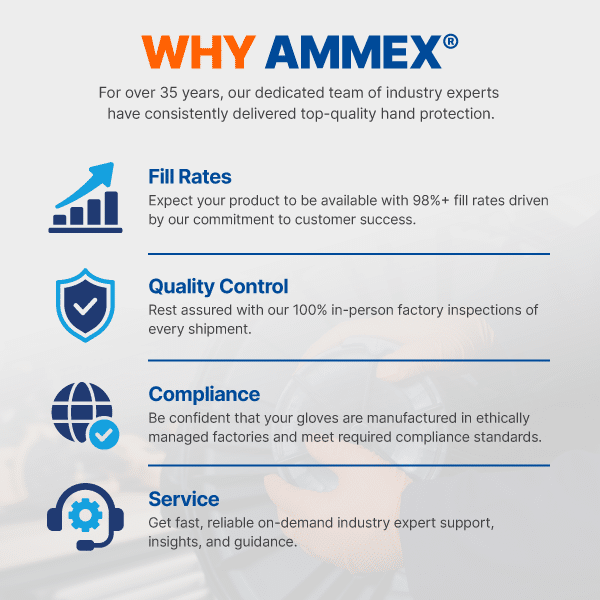
Along with the quality of our nitrile disposable gloves and their ability to protect from fentanyl, we are most proud of our ability to bring these products to the market consistently. With over 98% fill rates, our customers can be sure we have them in stock and ready to ship immediately.

“Beyond the needed focus on glove offering hand protection from fentanyl, we are placing priority on ensuring that our customers have unsurpassed, reliable access to these nitrile disposable gloves with our outstanding fill rates, top-notch customer service, and logistics support”, says Andre Chernih, Chief Marketing Officer at AMMEX.

Next time you have a question about fentanyl hand protection, reach out to AMMEX.

Check out our previous blog posts about hand protection from fentanyl here.

Why Are Fill Rates So Vital to Disposable Glove Distribution?

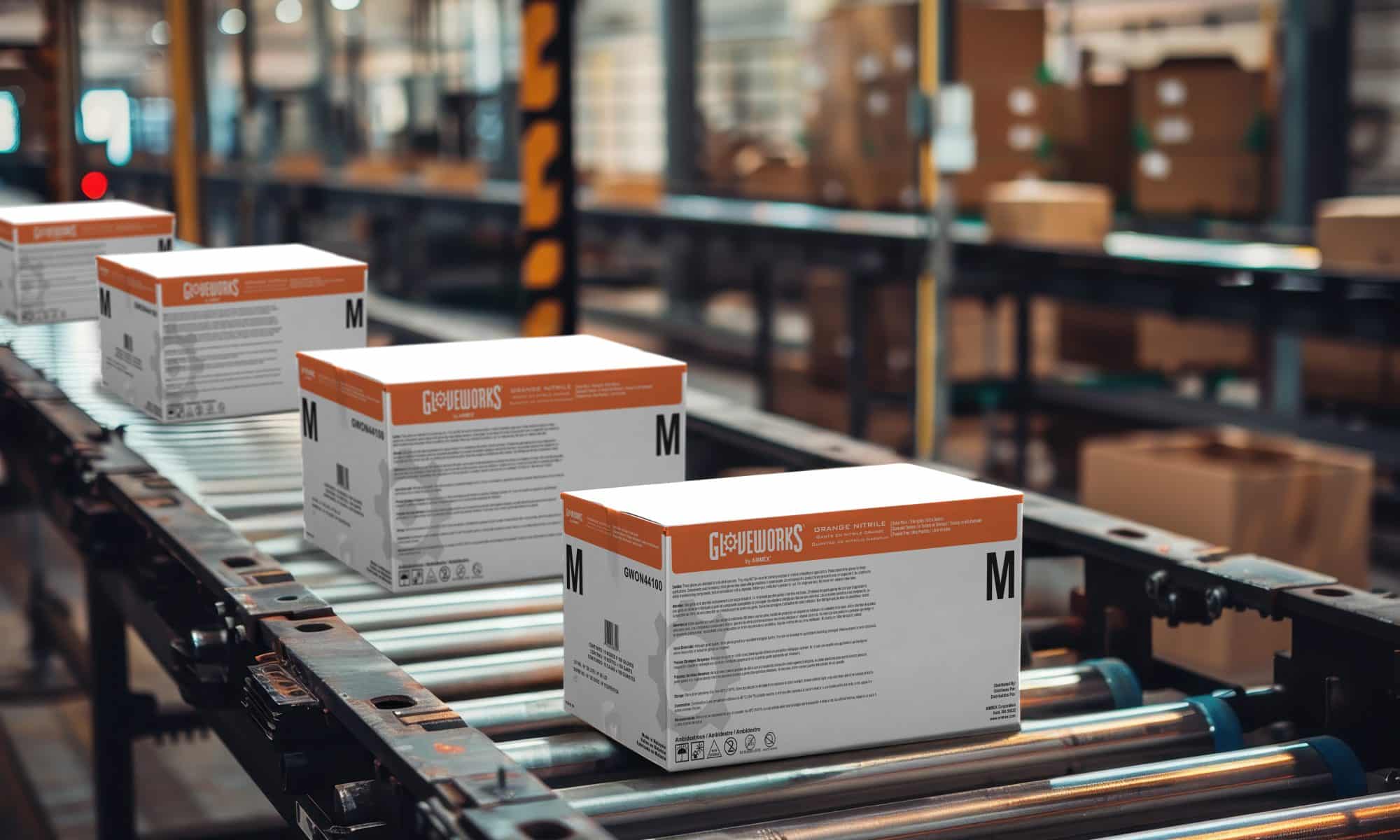
Cases of Gloveworks gloves on conveyor ready for courier distribution

Have you ever found a great product only to be disappointed that you could not buy it again? Despite thousands of product options and thousands of sellers, this is a common scenario in the world of disposable gloves. Because over 90% of disposable gloves are manufactured halfway across the globe, it has not been easy to find the product you love consistently and precisely when needed.

It does not have to be that way. In an industry where fill rates routinely fall below 70%, AMMEX has been able to achieve fill rates of over 98% for its leading brands—Gloveworks®, X3®, and AMMEX Professional®—making things easier and more predictable for those who rely on disposable gloves for hand protection.

What are fill rates, and how can AMMEX achieve such outstanding results? Fill rates reflect a distributor’s ability to fill an order with available products. Many manufacturers calculate fill rates based on the orders they fill eventually, even after several weeks on backorder. At AMMEX, we go a step further, calculating fill rates only on products available to fill at the precise moment of the order, not at some point down the road. Our ability to deliver high fill rates helps us minimize business disruptions, support regulatory compliance, and enable our distribution partners to serve everyone better using our disposable gloves. Our high fill rates signal robust inventory and underline our excellence in supply chain management.

“100% of our focus is on ensuring that our customers have the gloves they need when they need them.  This sounds simple but has required us to consistently innovate our supply chain options over the 35+ years in business”, says Keyo Gold, CEO of AMMEX.

Next time you encounter a challenge finding the right disposable glove, contact AMMEX. With our exceptionally high fill rates of over 98%, we’ll aim high to meet your expectations.

Check out our previous blog post about our fill rates here.

Q2 Market Update: Tariffs and Production Costs

Q2 Market Update: Production Costs

Third in a series

Our Q2 Market Update covers the potential impact of tariffs, but we were never under any illusion that it would age well with all the rapid news and changes.  As of mid-May, while many reciprocal tariffs remain on hold, last week, the US and China announced a reduction in tariffs, with US tariffs on China reduced to 30% for 90 days.

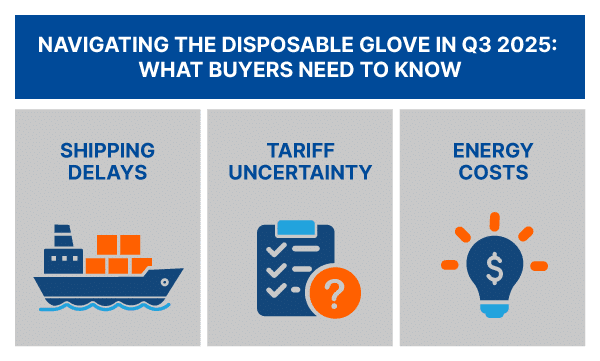
We expect the tariff news to continue and news around this topic to remain dynamic. However, when it comes to disposable gloves, many other factors that impact glove production costs continue to develop. Raw material costs remain the most significant expense category, accounting for a large portion of total disposable glove production costs.

Nitrile butadiene rubber (NBR), a primary component in nitrile gloves, could experience supply constraints due to production shifts out of China, maintenance at major chemical facilities, and increasing competition from the automotive and construction industries for nitrile-based gloves.

Meanwhile, manufacturing bottlenecks are appearing as production facilities are challenged with labor costs, rising energy costs, implementation of new quality control measures in the wake of regulatory changes, and technological transition challenges as manufacturers upgrade equipment.

Price volatility for natural rubber latex has decreased due to a balanced supply from Southeast Asian producers. NBR prices, however, remain elevated due to continued strong demand and petroleum price fluctuations. The price spread between natural latex and nitrile has narrowed compared with historical averages.

Another key variable is energy, which represents up to a growing portion of production costs and has significant regional variations. Among the cost factors are electricity prices, with manufacturing facilities in Southeast Asia facing 5-7% higher electricity costs compared with 2024.

What happens with tariffs will continue contributing to all the abovementioned factors. Besides the direct added cost, tariffs may also reshape the existing trade routes, leading raw materials, labor, and products to move in different ways in the future. Stay tuned for more updates.

Download our Q2 Disposable Glove Market Update.

Missed our first post of the series: Q2 Market Update: Tariffs Take Centerstage? Check it out here.

Missed our second post of the series: Q2 Market Update: Logistics Always a Factor? Check it out here.

Q2 Market Update: Tariffs Take Centerstage

Q2 Market Update: Tariffs Take Centerstage

First in a series

As we progress into Q2 2025, the disposable glove market and the rest of the business world are fixated on the impact of tariffs. Naturally, this is one of the main topics for our Q2 Market Update and will continue to be dynamic throughout the coming weeks.

As of mid-April, the U.S. government has implemented tariffs of up to 145% on all products from China and 10% on products from across the globe. It appears to be using the potential of additional tariffs as leverage or a tool to remake trade agreements worldwide. However, that may further scramble supply chains and trade flows that are already changing as companies seek alternatives to China as the source of their goods.

Experts say the result could be a domino effect of protectionism, with countries turning inward and raising tariffs in response to American trade barriers. The upheaval could also generate a new cast of regional alliances and ultimately reduce the importance of the United States in trade with Asia.

The disposable glove market is likely to feel the impact of trade wars simply because over 90% of production is outside of the United States and is beholden to global supply and logistics networks.

Download our Q2 Disposable Glove Market Update.

Disposable Gloves and Sustainability – What’s the Impact?

As disposable glove use has skyrocketed over the last three decades, evaluating sustainability options for them has become increasingly important, almost fashionable.

Of course, it would be interesting to imagine gloves that magically vanish after use or could be recycled on a grand scale.  There’s much conversation surrounding gloves’ biodegradability, recyclability, or compostability. However, at least for now, these efforts may be largely impractical. To summarize, here are some of the solutions that are often marketed as sustainable and that may border on greenwashing:

  • Biodegradable gloves are a nice idea, but most solutions do not meet proper biodegradability standards in states such as California.
  • Compostable gloves, even when they meet the requirements, often require specialized commercial composting facilities, which are not universally accessible.
  • Recycling gloves are frequently unfeasible due to limited availability, high cost, and contamination.

Even if some of these materials and practices were to become more feasible, more than 99% of gloves sold worldwide do not involve them. Their impact is just too small to measure.

The more immediate impact of improving the sustainability of disposable gloves is less about the “glamourous” promises of new materials and more about impacting the overall CO2 emissions during their production and transportation. Due to their peculiar supply chains, hundreds of billions of gloves are transported worldwide.

AMMEX – Commitment to Impact on Sustainability

Our focus is on measurable, reportable, and auditable environmental sustainability. By aligning reduction targets with climate science, we are concentrating efforts on reducing emissions. The Science Based Targets initiative (SBTi) has approved AMMEX’s near-term science-based emissions-reduction target: We commit to a 42% reduction in our operational carbon emissions (from a 2022 baseline) by 2030.

We are committed to long-term measurement and review of our approach to sustainability. As always, efficiency in transporting disposable gloves will remain a priority, even without established benchmarks.

For more information, visit our website or download our sustainability report. By focusing on emissions within our supply chain—areas we can directly influence—and collaborating with our manufacturers to minimize their impact, AMMEX aims to drive a meaningful impact on disposable glove sustainability.