


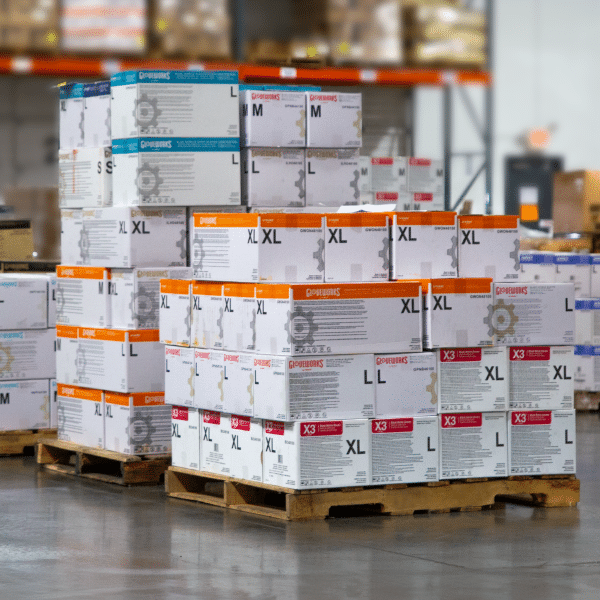
In the disposable glove industry, product quality and pricing matter. But when gloves are not available to ship when customers need them, neither quality nor price can solve the problem. That is why product fill rates remain one of the most important performance metrics in disposable glove distribution.
A fill rate percentage measures a supplier’s ability to fulfill customer orders from available inventory. While some companies calculate fill rates based on orders eventually shipped after delays or backorders, AMMEX measures First Pass Fill Rate, the percentage of orders shipped complete and on time when the order is received. This approach provides a more accurate reflection of product availability and supply chain performance.
High fill rates, consistently over 98%, help AMMEX create a significant competitive advantage for its customers. Customers can depend on a reliable supply of disposable gloves to help maintain workplace safety, hygiene standards, and daily operations. Whether serving automotive technicians, food service workers, manufacturers, or janitorial professionals, disposable glove suppliers who consistently deliver the right products at the right time build customer trust and improve retention.
High fill rates also reduce costs throughout the supply chain. When distributors trust their glove supplier’s ability to keep products in stock, they can operate with greater confidence and avoid carrying excessive inventory. This helps free up working capital while reducing the risk of stockouts, emergency purchases, and operational disruptions. Reliable product availability enables better forecasting, purchasing, and inventory management.
Maintaining high fill rates is not simple in the global disposable glove market. More than 90% of disposable gloves are manufactured in Southeast Asia, creating challenges that include long lead times, transportation disruptions, fluctuating logistics costs, raw material volatility, and changing global trade conditions. AMMEX consistently achieves 98%+ fill rates through sustained investment in supply chain planning, diversified sourcing strategies, effective inventory management, and close collaboration with manufacturing partners.
For over 35 years, AMMEX has focused exclusively on disposable gloves and developed a redundant supply chain designed to support industry-leading fill rates exceeding 98% on all leading product brands such as Gloveworks®, AMMEX Professional®, and X3®, over many years, not just at a moment in time.
In today’s disposable glove market, which faces disruptions from global conflicts, inflation, and unpredictable logistical challenges, supply reliability is often the key difference-maker in keeping workers safe with dependable hand protection.
In the end, consistently high fill rates are more than a supply chain metric. They are a direct measure of a supplier’s ability to support customer success and satisfaction.
To help further, here are common questions we face about our disposable glove fill rates:
What is the AMMEX definition of a disposable glove fill rate?
A fill rate is the percentage of customer orders that can be fulfilled immediately from available inventory. In disposable glove distribution, a high fill rate indicates strong product availability, reliable inventory management, and an efficient supply chain. AMMEX measures First Pass Fill Rate, which reflects the percentage of orders shipped complete on the day they are received.
What is a good fill rate in disposable glove distribution?
A good fill rate generally indicates that products are consistently available when customers place orders. Higher fill rates reduce stockouts, backorders, and operational disruptions. AMMEX constantly delivers industry-leading 98%+ fill rates on all key products.
Why are fill rates important for distributors?
High fill rates help distributors improve customer satisfaction, reduce inventory risk and cost, and maintain reliable product availability. Ultimately, high fill rates help build customer trust in the glove supplier.
How do fill rates affect workplace safety?
Consistent glove availability helps organizations maintain hand protection programs and avoid disruptions caused by product shortages. In many industries and applications, working without gloves is no longer an option workers are willing to accept.
What causes low glove fill rates?
Supply chain disruptions, manufacturing delays, inventory shortages, freight bottlenecks, poor planning, and inaccurate demand forecasting can all contribute to lower fill rates.
AMMEX® | The Right Glove for the Job®