


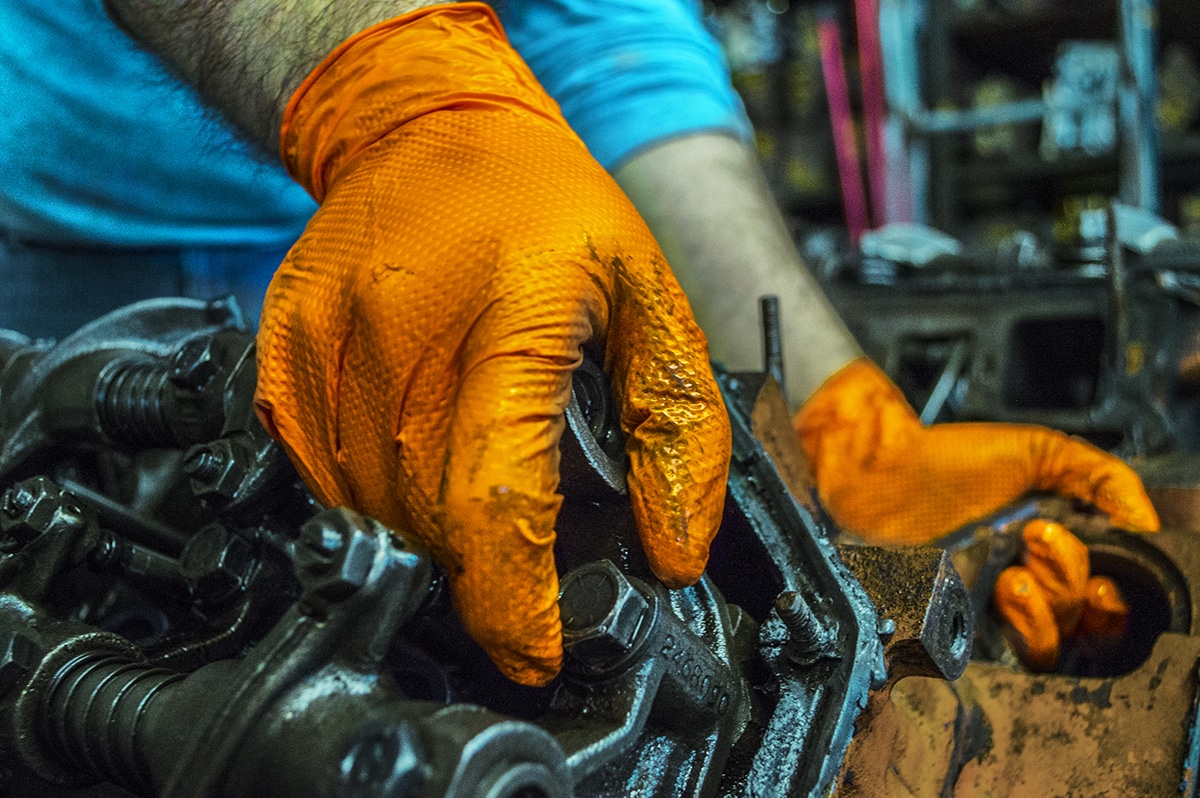
Since 1988, AMMEX has protected countless hands across countless industries. One area in which we’ve always thrived is automotive service, where our Gloveworks Nitrile with Raised Diamond Texture, in orange, green, black, or royal blue, have been go-to gloves for at least a decade.
Technology has drastically changed automotive service over the years. Cars are smarter than ever, their diagnostics more precise and controlled by computer chips. Mechanics train extensively in a wider spectrum of systems and disciplines.
As cars and trucks continue to evolve, so does vehicle maintenance—and the tools needed to do the job. A goodly portion of auto repair has become cleaner as some greasy parts have given way to circuit boards.
But when it’s time to start rooting around the engine compartment, auto techs face the same situation they have for decades: Working on cars (and trucks) can be dirty, difficult, and dangerous—and you would be wise to protect your hands accordingly.
The liquids in motor vehicles—radiator coolant, oil, brake, power steering, and transmission fluids—are toxic. So are the chemicals most shops use for cleaning and for mixing paint. And body work introduces another whole set of substances, like isocyanates, solvents including toluene, xylene, and methylene chloride, and heavy metals like lead, cadmium, and chromium.

The industry is experiencing ever-growing adoption of gloves. It’s not, however, a one-size-fits-all solution—users want options.
How do you decide? Start by looking at which chemicals are present on your shop floor and what work your techs are doing. Then turn to AMMEX’s Chemical Resistance Chart, which lists commonly used chemicals and the gloves that are recommended for use with them.
As many as 1 million hand injuries occur in workplaces each year, ranging from cuts and lacerations to chemical exposure.
Statistically, wearing gloves reduces the relative risk of hand injury by 60 percent. A hand safety policy, along with the use of appropriate hand protection, can reduce or eliminate many of those injuries from your workplace.
Like anything, disposable gloves can be the subject of debate. Are they necessary? Well, considering that working on cars (and trucks) is not kind to technicians’ hands, it would seem so.
If you’re considering whether gloves are right for your shop, you may be operating under an erroneous precept. The more appropriate question might just be, “Which AMMEX glove is right for your team?”
Try RDT for yourself, and you may never want to wear any other disposable glove. Visit ammex.com or call 1-800-274-7354 to learn more.
Let us help you choose the right glove for the job.