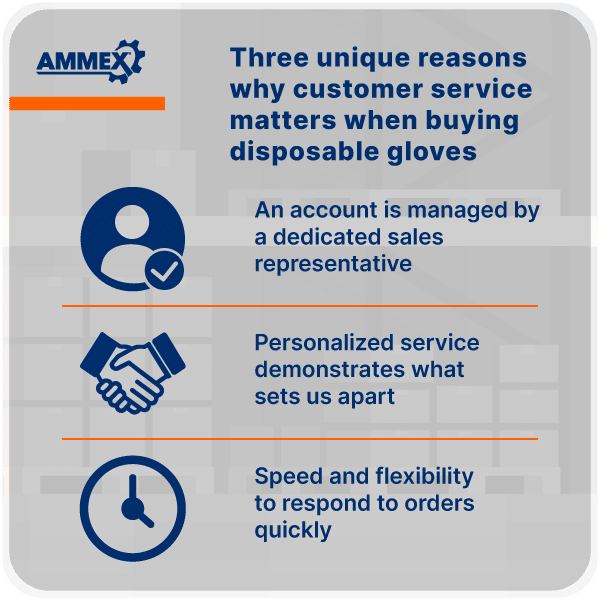
In the disposable glove industry, exceptional service isn’t just a friendly add-on; it’s a necessity that helps customers buy the right glove. Disposable glove products may seem simple, but most companies routinely offer 40+ product options. Customer service at AMMEX shows that service excellence sets industry leaders apart in three unique ways.
First, an account at AMMEX is actively managed by a dedicated sales representative, who allows for a detailed understanding of customer needs and wants. Our expert representatives can effectively align one of our glove products with the customer’s needs.
Second, our personalized service allows us the opportunity to efficiently explain to prospects and customers why AMMEX is different and what sets us apart from the competition. From our industry-leading product fill rates to in-person quality control and compliance processes, our service team can offer proof of how AMMEX does things differently.
Third, in a fast-moving market, speed and flexibility matter. AMMEX responds quickly to orders, often delivering within days, and adapts to shifting demands or market opportunities—thanks to agile systems and customer feedback loops.
A real-world example underscores these strengths. Recently, a distributor using AMMEX gloves reversed rising costs by replacing their glove vendor with alternatives recommended by an AMMEX representative. The savings become even more impactful when considering that AMMEX provided higher on-time fill rates to reduce storage costs, improved quality to minimize customer concerns, and tools such as no-cost samples to help make glove user decisions easier.
In a disposable glove market with low-cost options, outstanding service can help distinguish the leader from the rest. AMMEX’s approach demonstrates that service isn’t a luxury in the disposable glove industry; it’s the foundation of customer trust, efficiency, and long-term success.
Check out our previous blog post about How AMMEX Supports Buyers in a Volatile Glove Market.