


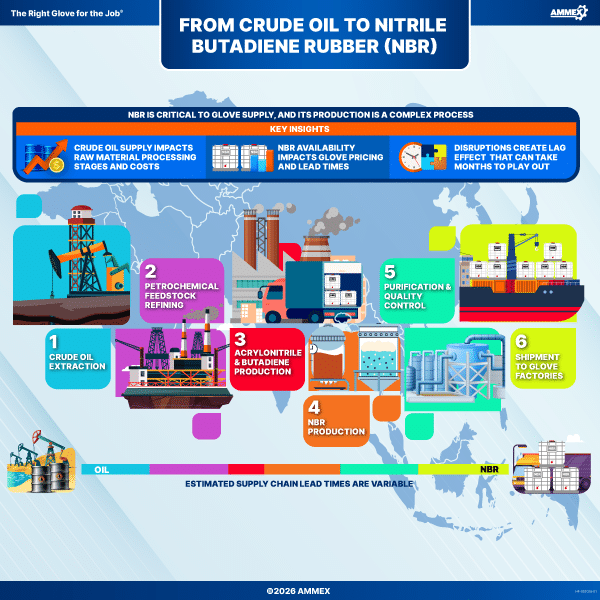
The recent volatility in the disposable glove market has highlighted an often-overlooked reality: gloves do not appear overnight. Behind every nitrile glove is a complex global supply chain that begins with crude oil and spans multiple continents, manufacturing processes, and months of production time. As illustrated in our most recent infographic, which can be seen above, the journey from crude oil to nitrile butadiene rubber (NBR), the primary raw material used in nitrile gloves, involves numerous interconnected steps, each with its own risks, costs, and potential delays.
The process begins with crude oil extraction, much of which originates in the Middle East. Notably, many refineries that produce NBR are optimized for operations suited to the chemical characteristics of Middle Eastern oil. Once extracted, crude oil undergoes petrochemical feedstock refining, where it is transformed into chemical building blocks used in countless industrial products. These feedstocks are then processed into acrylonitrile and butadiene, the two critical components required to manufacture NBR. The production of NBR itself is a highly specialized chemical process that requires precise conditions and significant manufacturing capacity. After production, the material must undergo purification and quality control before it can be shipped to glove manufacturers. Only then can it be converted into the disposable nitrile gloves used every day in healthcare, food service, industrial environments, and countless other applications.
This lengthy supply chain explains why disruptions often have a greater impact than many disposable glove buyers expect. For example, when crude oil prices rise, or when oil refinery output is constrained, or shipping routes are disrupted, and chemical production slows, the effects ripple across all stages. A seemingly small increase in cost or lead time at each step can compound significantly by the time NBR reaches nitrile glove factories. As a result, even a modest increase in costs or delays across multiple stages can create disproportionate upward pressure on raw material pricing and glove costs.
Perhaps most importantly, the market does not respond immediately when conditions improve. If crude oil prices decline or supply constraints ease, it can take months for those benefits to work through refining, chemical production, NBR manufacturing, shipping, and glove production. This lag effect means glove pricing and availability, particularly in North America, often reflect conditions that occurred several months earlier, not current market headlines.
As a disposable glove supplier with over 37 years in disposable glove sourcing and operations, AMMEX has a detailed understanding that the path from crude oil to NBR provides a unique context for today’s glove market. NBR is not a simple commodity, and its production cannot be accelerated overnight. The complexity of the supply chain can persist long after the initial event, which is why managing glove supply requires a long-term perspective. For distributors and end users alike, understanding these dynamics is essential to navigating market fluctuations and making informed purchasing decisions. AMMEX is here to help, as our unique experience in navigating turbulent market conditions allows us to maintain industry-leading 99%+ fill rates across all disposable glove products and support our customers with outstanding service regardless of market conditions.
AMMEX® | The Right Glove for the Job®